Portable Traffic Signals
Trailer-mounted temporary signals for one-lane, two-way operations.
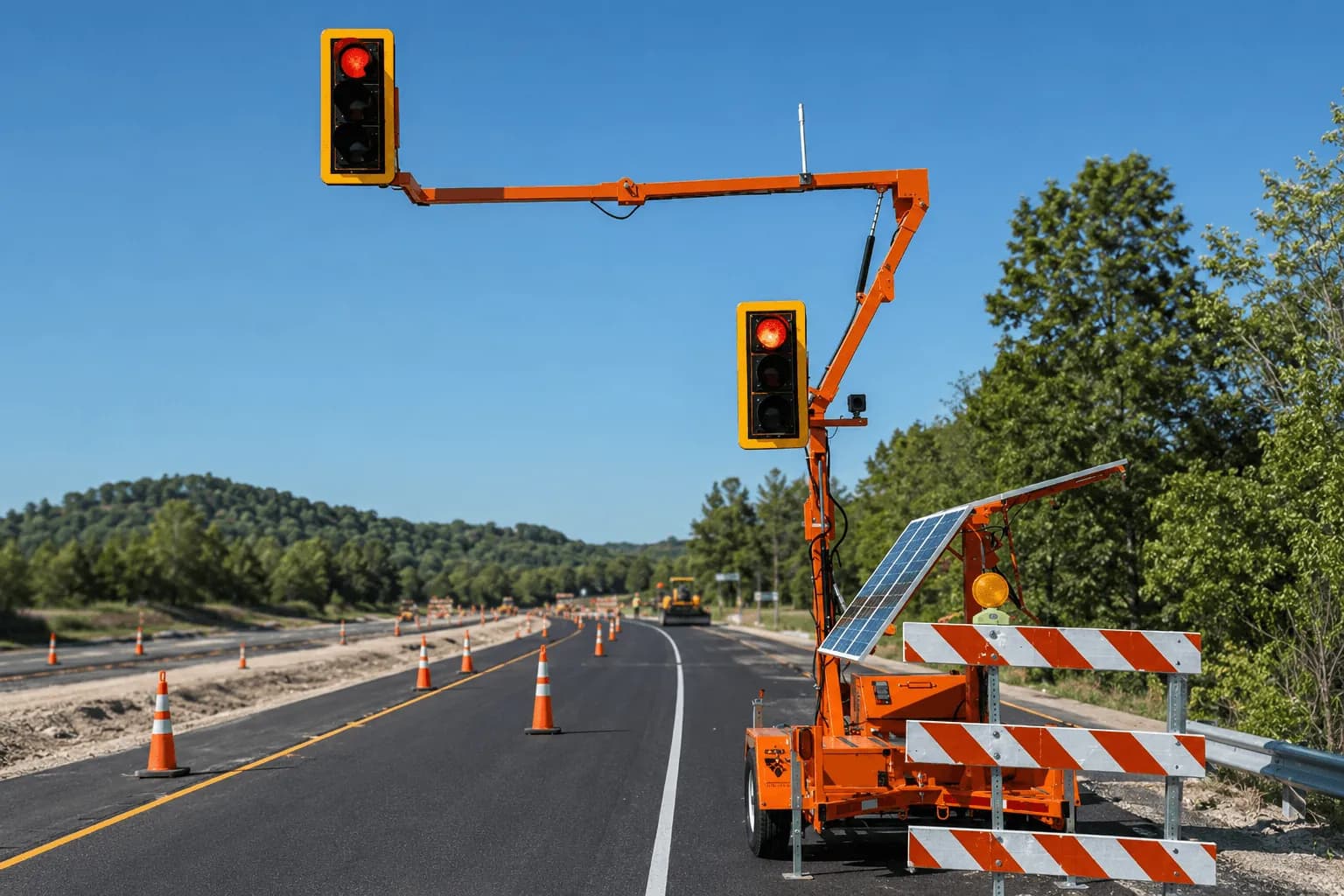
When a two-lane road narrows to one, somebody has to decide whose turn it is. For decades that meant two flaggers, two radios and a great deal of trust. A portable traffic signal does the same job with a pair of trailer-mounted heads and a controller — and takes the people out of the live lane.
The economics follow the duration. A flagging pair is cheaper for an afternoon; a signal is cheaper by the second week. What you buy after that is consistency: a portable signal shows the same indication at three in the morning in the rain as it did on the first clear Monday.
That matters most exactly where flagging is hardest — night work, long-duration closures, and stretches where sight distance makes standing in the road hazardous. On those jobs a signal is frequently the safer option outright, not just the cheaper one.
A-1 Barricades rents portable traffic signals across the Chattanooga area for bridge and culvert work, slide repair, paving, and utility cuts that hold a lane for days rather than hours.
What's in this category
- Trailer-mounted signal pairs
- Two self-contained heads on towable trailers, positioned at each end of the one-lane section and linked so they can never both show green.
- Controllers
- Fixed-time, vehicle-actuated and manual-override control. Actuated units use radar or detection to skip an empty approach rather than holding traffic against nothing.
- Radio link
- Wireless communication between the heads, so no cable is run across the work — the usual arrangement on anything longer than a short section.
- Solar and battery power
- Solar arrays with battery reserve sized to run through overcast stretches, so the signal does not depend on a generator or a site feed.
- Advance warning sign packages
- ONE LANE ROAD AHEAD, SIGNAL AHEAD and BE PREPARED TO STOP signs on stands — the signing that has to be in place before the signal means anything to an approaching driver.
Benefits of portable traffic signals
Portable traffic signals offer several benefits over using flagmen at roadway construction sites. They provide consistent and predictable traffic control, reducing the possibility of human error or miscommunication. Signals can operate continuously, allowing traffic to move safely even when workers are not actively directing vehicles. Portable traffic signals don't take breaks or become distracted by cell phones.
This can improve worker safety by keeping flagmen away from moving traffic and reducing their exposure to passing vehicles. Portable signals can also improve traffic flow by coordinating vehicles traveling in opposite directions and minimizing unnecessary delays. Additionally, they can reduce labor costs because fewer workers may be needed for traffic control. Overall, portable traffic signals provide a safer, more efficient, and reliable method of managing traffic through construction zones.
Getting it right
The clearance interval is the whole design
Everything else about a portable signal is convenience; the all-red clearance is the safety case. It has to be long enough for the slowest vehicle that entered on the last green to clear the entire one-lane section before the opposing side turns green. Set it from the measured length of the section and the realistic speed through it — not from a default in the controller. Get it short and you have arranged for two vehicles to meet in a lane built for one.
A signal does not replace the plan or the approval
Portable traffic control signals operate on public roadways under the MUTCD and require the approval of the agency with jurisdiction — TDOT on state routes, the city or county elsewhere. That normally means an approved traffic-control plan showing signal positions, advance signing and timing. We supply and deliver the equipment; the approval is between you and the agency, and it is worth starting early.
Where a signal beats a flagger — and where it does not
Signals win on duration and on attention. A signal holds the same red for the ten-thousandth car as it did for the first — no fatigue at hour nine, no lapse while a phone buzzes, no gap at lunch or shift change, and no one standing in a live lane for weeks to make it happen. That consistency is worth most at night, in poor weather, on low-volume roads where a flagging pair spends the shift waiting, and anywhere sight distance makes flagging hazardous. Flaggers still win where the geometry changes hour to hour, where driveways and side streets need judgement, and where equipment crosses the open lane on no fixed schedule. Plenty of jobs use both — a signal on the main section, a flagger at the access point.
Where we work
A-1 Barricades operates from 1415 Stuart Street in Chattanooga and has supplied traffic-control equipment across the Southeast since 1977.
20Communities across 3 states
Southeast Tennessee
- Chattanooga
- East Ridge
- Red Bank
- Soddy-Daisy
- Signal Mountain
- Hixson
- Ooltewah
- Collegedale
- Cleveland
- Dayton
- Jasper
Northwest Georgia
- Fort Oglethorpe
- Ringgold
- Dalton
- LaFayette
- Chickamauga
- Trenton
Northeast Alabama
- Bridgeport
- Stevenson
- Scottsboro
Portable Traffic Signals questions
What is a portable traffic signal?
A pair of trailer-mounted traffic signal heads with a shared controller, used to run alternating one-way traffic through a section of road that has been narrowed to a single lane. The heads are interlocked so both can never show green, and they are positioned at each end of the one-lane section with advance warning signs on the approaches.
When should I use a portable traffic signal instead of flaggers?
Duration and exposure are the deciding factors. A portable signal runs 24/7 — no lunch breaks, no shift changes, no phone in anyone's hand, nothing pulling its attention off the one thing it is there to do — so it is the stronger choice on multi-day and multi-week closures, on night work, in bad weather, on low-volume roads where a flagging pair spends most of a shift waiting, and anywhere sight distance makes standing in the road hazardous. Flaggers remain better where the site geometry changes constantly or where drivers need human judgement — construction traffic crossing the open lane, active driveways, changing access.
Do I need approval to use a portable traffic signal?
Yes. Portable traffic control signals on public roadways fall under the MUTCD and require approval from the agency with jurisdiction — the Tennessee Department of Transportation on state routes, the city or county on local roads. Expect to submit a traffic-control plan showing signal placement, advance signing and the timing you intend to run. Start that process before your dates rather than alongside them.
How are portable traffic signals powered?
Solar, with a battery reserve sized to carry the unit through overcast stretches and long nights. That is what makes them practical on rural and bridge work where there is no power to tap and running a generator for weeks is neither cheap nor quiet.
Can I rent portable traffic signals in Chattanooga?
Yes — portable signals are rented by the job across the Chattanooga tri-state area and delivered on our own trucks. Call (423) 265-3054 with the length of the one-lane section, the approach speeds, your dates, and whichever agency has jurisdiction over the road.
Need gear on site?
Call for a quote, to reserve rentals, or to check stock. The people who answer the phone know the equipment.