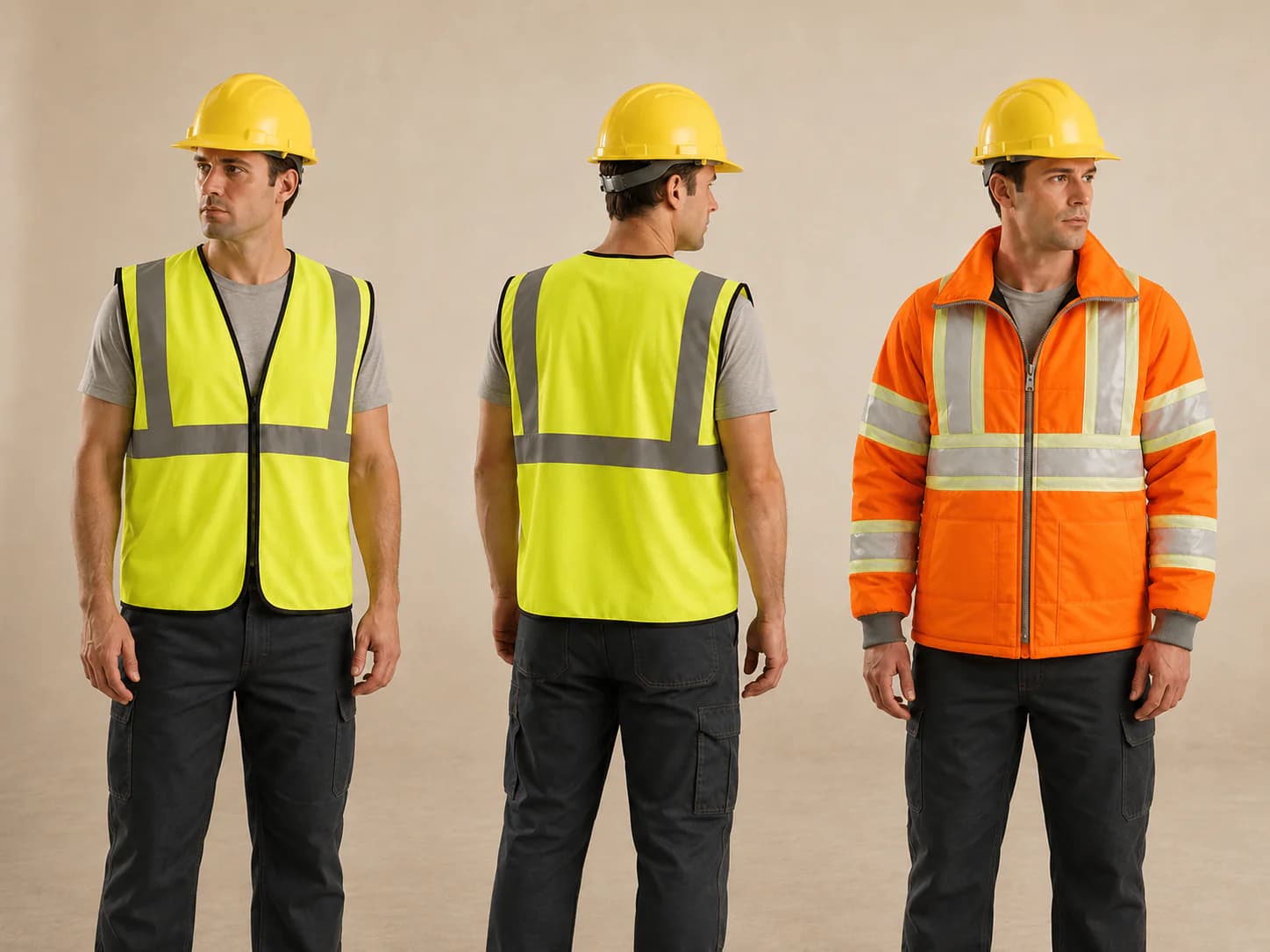
High-visibility apparel is the last line of protection in a work zone — the thing that makes a worker readable as a person when everything else has failed. It is also the most regulated item on this page: federal rule requires ANSI-rated garments for workers in federal-aid highway rights-of-way, and the class is not a matter of preference.
A-1 Barricades stocks Class 2 and Class 3 vests and outerwear along with hard hats and job-site gear, so a crew can be outfitted from the same supplier that provides the devices around them.
What's in this category
- Class 2 vests
- The standard roadway vest. Required for workers exposed to traffic above 25 mph and for most highway and utility work.
- Class 3 vests and jackets
- Sleeved garments with the greatest background and retroreflective area, for high-speed roadways, night work and poor visibility.
- Class 1 vests
- For work well removed from traffic — parking areas, warehouse yards and sites where vehicles move slowly.
- Hi-vis outerwear
- Rain jackets, insulated coats and bomber jackets that keep a crew compliant in weather.
- Hard hats
- ANSI Z89.1 Type I and Type II hard hats in the full color range used for role identification on site.
- Job-site gear
- Gloves, eye protection and the everyday consumables a crew burns through.
Getting it right
Class 2 is the floor on a roadway, not the ceiling
If workers are in a federal-aid highway right-of-way, Class 2 is the minimum the rule allows. Night work, high-speed traffic and poor weather all argue for Class 3, because sleeves add the limb movement that lets a driver recognize a shape as a human being rather than as an object.
Retroreflective tape has a service life
Hi-vis garments fail gradually and invisibly. Washing, abrasion, UV and dirt all reduce the fluorescent background and the reflective tape's return. A faded vest still looks like a vest in daylight and performs poorly at night — replace on condition, not when it falls apart.
Type I and Type II hard hats are not interchangeable
Type I protects against impact to the top of the head. Type II adds lateral protection — the side, front and back. Where there is a risk of struck-by from an angle, or of a fall, Type II is the appropriate selection.
Where we work
A-1 Barricades operates from 1415 Stuart Street in Chattanooga and has supplied traffic-control equipment across the Southeast since 1977.
20Communities across 3 states
Southeast Tennessee
- Chattanooga
- East Ridge
- Red Bank
- Soddy-Daisy
- Signal Mountain
- Hixson
- Ooltewah
- Collegedale
- Cleveland
- Dayton
- Jasper
Northwest Georgia
- Fort Oglethorpe
- Ringgold
- Dalton
- LaFayette
- Chickamauga
- Trenton
Northeast Alabama
- Bridgeport
- Stevenson
- Scottsboro
Safety Apparel questions
What ANSI class vest do road workers need?
Class 2 is the practical minimum for roadway work, and federal rule 23 CFR 634 requires all workers within a federal-aid highway right-of-way to wear high-visibility apparel meeting ANSI/ISEA 107 Class 2 or Class 3. Class 3 is appropriate where traffic speeds are high, work happens at night, or visibility is otherwise degraded.
What is the difference between Class 2 and Class 3 high-visibility apparel?
Coverage. Class 3 garments carry substantially more fluorescent background and retroreflective material than Class 2, and they include sleeves. That added coverage on the arms is what conveys motion and human form to a driver at distance, which is why Class 3 is specified for high-speed and nighttime work.
When does a hard hat need to be replaced?
Replace immediately after any impact, even without visible damage, and replace when the shell shows cracking, chalking, gouging or brittleness, or when the suspension is damaged. Manufacturers also publish service-life guidance from the date of manufacture, and the date is stamped inside the shell.
Do you carry hi-vis apparel for cold and wet weather?
Yes — hi-vis rain gear, insulated coats and jackets that carry the ANSI class rating, so crews stay compliant when the weather turns rather than covering their vest with a non-rated coat.
Need gear on site?
Call for a quote, to reserve rentals, or to check stock. The people who answer the phone know the equipment.