Temporary Fencing
Panel fence, bases, gates and screen for job sites and events.
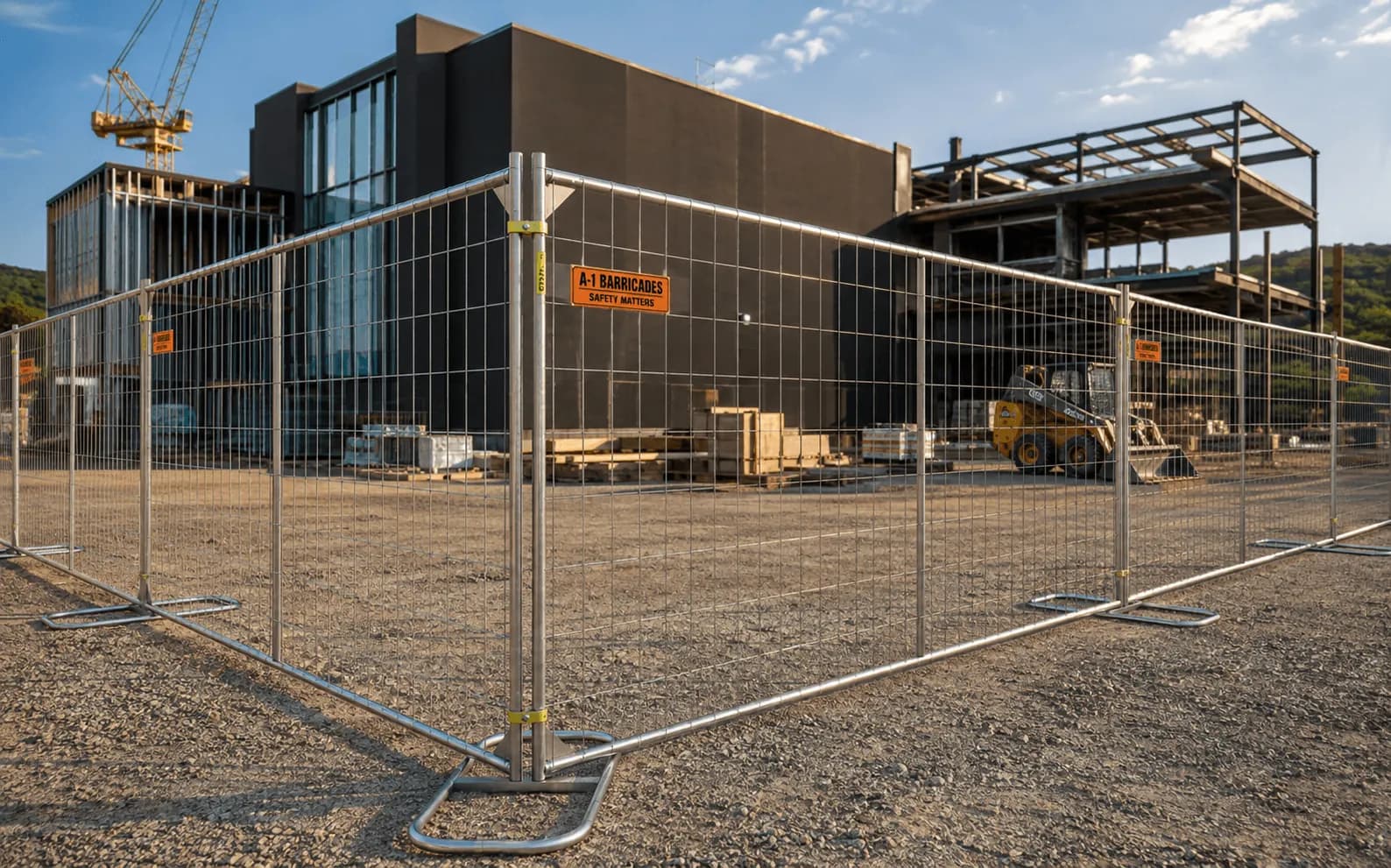
Temporary fence does two jobs that get budgeted as one. It keeps the public out of the work — the liability job — and it keeps the work's material, tools and machines from walking off overnight — the money job. A site that gets the first right and the second wrong still ends up filing a claim.
The panel system that dominates both is the same: six-foot welded-mesh or chain-link panels standing in weighted bases, clamped end to end, with no post driving and no ground disturbance. It goes up in a morning, follows the work as the work moves, and comes down without leaving holes in someone's parking lot.
A-1 Barricades supplies panel fence and its hardware across the Chattanooga area for construction sites, demolition, storm response, festivals and ticketed event perimeters.
What's in this category
- Panel fence
- Freestanding galvanised welded-mesh or chain-link panels in a steel frame, typically six feet tall, that stand in bases and clamp together. No digging, no driven posts, no restoration afterwards.
- Bases and couplers
- Moulded or concrete feet that carry the panels, and the clamps that lock adjacent panels into a rigid line rather than a row of independent sails.
- Windscreen and privacy screen
- Plain or printed mesh laced to the fabric. Cuts sightlines, holds dust and gives a project a finished face — and materially changes what the fence has to be ballasted for.
- Gates and access panels
- Swing and rolling gate panels for vehicle and pedestrian entry, so the access points are designed in rather than cut in later.
- Pedestrian and crowd fence
- Shorter interlocking panels for event perimeters, queue management and crowd separation where a six-foot site fence would be the wrong instrument.
- Plastic safety fence
- High-visibility orange mesh on posts — the fast, light option for marking a hazard, an excavation edge or a keep-out area that does not need to resist anyone.
- Ballast and anti-climb hardware
- Sandbags and ballast blocks for wind exposure, plus anti-lift clamps and anti-climb fittings for urban sites and anything left standing overnight.
Getting it right
Windscreen turns a fence into a sail
This is the single most common temporary-fence failure, and it is entirely predictable. An open mesh panel lets wind through; the same panel with screen laced to it catches nearly all of it. Add screen without adding ballast and the first strong front lays the run flat — across a sidewalk, or across a lane. If the job wants screen, the ballast plan has to be recalculated for the screened condition, not the bare one.
A fence is not automatically a pedestrian route
Closing a sidewalk with fence and calling it done leaves pedestrians to improvise, usually into the roadway. The temporary route has to be defined, protected from traffic, and detectable at cane height for people with visual impairments — which panel fence in bases does not provide on its own, because the gap under the panels reads as open. Pair the fence with a continuous channelizing device where the route runs beside live traffic.
Count the gates before you count the panels
Fence layouts get planned as a perimeter length and then get cut apart on site because nobody asked where the concrete trucks enter, where the crew parks, or where the dumpster gets swapped. Walk the access points first, place the gates, then measure the runs between them. It costs an hour on paper and saves a change order.
Where we work
A-1 Barricades operates from 1415 Stuart Street in Chattanooga and has supplied traffic-control equipment across the Southeast since 1977.
20Communities across 3 states
Southeast Tennessee
- Chattanooga
- East Ridge
- Red Bank
- Soddy-Daisy
- Signal Mountain
- Hixson
- Ooltewah
- Collegedale
- Cleveland
- Dayton
- Jasper
Northwest Georgia
- Fort Oglethorpe
- Ringgold
- Dalton
- LaFayette
- Chickamauga
- Trenton
Northeast Alabama
- Bridgeport
- Stevenson
- Scottsboro
Temporary Fencing questions
How tall is temporary construction fencing?
Six feet is the standard panel height, which is what most jurisdictions and general contractors expect around an active site. Shorter interlocking panels are used for events and crowd separation, and low plastic safety fence is used for marking hazards rather than resisting entry.
Does temporary fencing need to be anchored into the ground?
No — that is the point of a panel system. Panels stand in weighted bases and clamp to each other, so nothing is driven into a parking lot, a slab or a finished surface. Stability comes from ballast and from the panels being locked together into a continuous line rather than left standing as individual units.
Can I put a printed screen on the fence?
Yes — printed windscreen is common for project boards, sponsor branding and event perimeters. Be aware that screen materially increases the wind load on the run, so the ballast has to be increased to match. Tell us the site's exposure and the length of run when you call.
Do I need a permit to fence off a sidewalk?
Almost certainly, from whichever jurisdiction owns the right-of-way — the city, the county or the state. Permits for sidewalk and lane occupancy commonly require a traffic-control plan showing the pedestrian route, and that route has to remain accessible. Start with the agency well before your dates; we supply the equipment, and the permit is between you and them.
Can I rent temporary fencing for an event?
Yes — festival perimeters, ticketed boundaries, back-of-house separation and crowd management are routine rental work. Reserve early for peak event weekends, when several events compete for the same panel count. Call (423) 265-3054 with your dates and footprint.
Need gear on site?
Call for a quote, to reserve rentals, or to check stock. The people who answer the phone know the equipment.